Alberta Driver’s Guide · Chapter 6Français
Emergency Situations and Challenging Conditions
This chapter covers emergency braking, loss of control, vehicle mechanical problems, challenging conditions, emergency supplies, animals, collisions, among other things.
10 sections · 2 signs illustrated
Emergency braking
Guide page 80
There are times when something unexpected occurs that requires you to brake suddenly. The key to emergency braking is to stop the vehicle as quickly as possible without losing control of your vehicle.
If your vehicle has ABS brakes
Most vehicles are equipped with an anti-lock braking system (ABS). The ABS allows you to steer while the brakes are being applied. ABS applies brake pressure at each wheel, cycling from locked to slightly rolling. You will feel this as a vibration through the brake pedal. With ABS you can brake as hard as you need without losing your ability to steer. To brake in an emergency, follow these steps:
- Apply steady firm pressure to the brake pedal.
- Do not pump or release the brake pedal.
- Look and steer in the direction you want to go. Check your vehicle’s owner’s manual for more information on emergency braking techniques.
If your vehicle does not have
ABS brakes
In vehicles without ABS, braking hard can cause the wheels to become ‘locked’ and stop rolling. This can cause you to lose steering control. If your wheels lock, ease off the brake pedal. Brake again but not as hard. To brake in an emergency, follow these steps:
- Press firmly on the brake pedal to the point just before the wheels lock. This is called threshold braking.
- If the wheels lock, release the brake pedal slightly to regain steering control.
- Press the brake pedal firmly again without locking the wheels.
- Look and steer in the direction you want the front of the vehicle to go.
Loss of control
Guide page 80
The road surface, the speed of your vehicle, turning, and the condition of your tires can contribute to a skid. Skidding means you have lost control of the vehicle. To regain control, do not touch the brake or the accelerator. Look and steer where you want the front of the vehicle to go. Most skids are the result of driver error. A skid can occur when you:
- drive too quickly on poor road conditions such as ice, snow, rain, mud, sand, or gravel
- turn the steering wheel too sharply
- turn the steering wheel too much for the speed you are travelling
- brake too firmly
- accelerate too quickly.
Skid recovery
Drive in a manner that reduces the possibility of having your vehicle skid. Plan ahead so you will not have to suddenly brake or steer. Driving in a smooth and controlled manner will reduce the chance of a skid. If the road is not familiar to you or the conditions are not ideal, reduce your speed. It is very important to keep your foot off the brake pedal if you start to skid. How you steer depends on the direction of the skid. Look and steer in the direction you want the front of the vehicle to go. Point the tires along the centre of your lane and do not make large steering adjustments. Look and steer in the direction you want the front of the vehicle to go. Note the position of the front tires (in red).
Braking skid (non-ABS)
If your vehicle does not have ABS, a braking skid could occur when you apply your brakes too firmly, causing the wheels to lock. Steering control will be lost. If you experience a braking skid, do the following:
- Take your foot off the brake pedal. When the vehicle’s wheels start to roll, steering control will return.
- Look and steer in the direction you want the front of the vehicle to go.
- If you need to apply the brakes again, use firm pressure but not hard enough to lock the wheels.
Power (acceleration) skid
A power skid occurs when you accelerate too quickly, causing the wheels to spin. If you experience a power skid, do the following:
- Take your foot off the gas pedal to allow the wheels to stop spinning.
- Make any needed steering corrections. Look and steer in the direction you want the front of the vehicle to go.
- Be careful not to over-correct your steering or you may skid in the opposite direction.
- Use gentle acceleration to continue moving forward.
Cornering skid
A cornering skid occurs when you are travelling too quickly when turning, causing the vehicle to slide sideways. Speed, tire condition, road surface, and the slope of the road can all play a part in this type of skid. If you experience a cornering skid, do the following:
- Take your foot off the gas pedal. Do not use your brakes.
- Look and steer in the direction you want the front of the vehicle to go.
Off-road recovery
If you drive off the paved portion of the roadway, do the following:
- Keep a firm grip on the steering wheel.
- Do not try to steer the vehicle back onto the road immediately.
- Take your foot off the gas pedal to reduce your speed.
- Try to avoid braking. If you need to brake, use gradual pressure on the brake pedal to keep control.
- Check for traffic before attempting to steer the vehicle back onto the road.
- With controlled speed, return to the road gradually and straighten your vehicle in the proper travel lane. Gradual return to the roadway.
Vehicle mechanical problems
Guide page 82
It is important to keep your vehicle working properly. If your vehicle breaks down while you are driving, it can be dangerous as well as inconvenient. If your vehicle is having mechanical problems that require you to stop, remember the following for your safety:
- Change lanes safely and park in a safe location, if possible.
- Do not stop on a bridge or in a tunnel. This can be very dangerous.
- If the vehicle is left in a potentially dangerous location, turn on your hazard lights (four-way flashers).
- Raise your hood.
- Carry reflective triangles. On the highway or in a location that is potentially dangerous, safely place reflective triangles to the rear of your vehicle, about 10 to 20 metres (33 to 66 feet) apart.
- Do not try to do roadside repairs on crowded or fast-moving highways.
- If it is a potentially dangerous situation, have all occupants leave the vehicle and wait at a safe location to the rear and away from the vehicle, as shown in the diagram. DO NOT WAIT IN THIS AREA Move away from the vehicle while waiting for help. If a motorist stops to offer help, you could ask them to call for assistance.
Brake failure
Most vehicles come with a brake system that will protect you against a total failure of your brakes. A warning light on your instrument panel will light if there is a problem. It should light before your brakes stop working. When you see the brake warning light come on, and you have checked that the park brake has been released, move to the side of the road as soon as it is safe to do so. If you have a vehicle with power brakes, the power system could fail. This may occur if your engine stops while you are still moving. If the vehicle does not slow with normal pressure on the brake, push the brake pedal harder and apply steady pressure. If your brakes fail, and your wheels are not turned, carefully use your park brake to slow your vehicle. You may be able to shift to a lower gear to bring your vehicle to a safe and controlled stop. Check your vehicle’s owner’s manual for more information. Park your vehicle in a safe location. Do not drive until the brakes have been checked and repaired properly.
Power steering failure
If your power steering fails, you can still steer the vehicle. You will have to use extra effort to turn the steering wheel.
Tire failure
If a tire has an air leak you may feel, the vehicle begin to pull and a vibration as you hold the steering wheel. If an air leak is not repaired soon, the tire will become flat. When a front tire is flat, the vehicle will pull strongly to the side that has the flat tire. A flat rear tire may make your vehicle weave. You may find it hard to steer. If a tire goes flat while you are driving:
- Resist the urge to immediately apply the brakes.
- Take your foot off the gas pedal and allow the engine to slow the vehicle down.
- Hold the steering wheel with a firm grip. Keep the vehicle on a straight course by looking and steering in the direction you want to go.
- When you have the vehicle under control and speed is reduced, apply the brake with gentle and steady pressure.
- Safely move to the emergency stopping lane or edge of the road, and park in a safe place.
- Turn on your hazard warning lights.
Headlight failure
If both headlights fail:
- Turn on your hazard lights.
- Turn the headlight control off and on.
- If the headlights are still not on, reduce your speed, safely move to the emergency stopping lane or edge of the road, and park in a safe place. Note: Replace a headlight or headlight bulb as soon as it burns out. Driving with only one headlight increases the risk of being without both headlights.
Challenging conditions
Guide page 83
When road conditions are poor due to bad weather, allow more time for your trip. Increase your following distance, reduce your speed, and maintain your space cushion. Driving at night: When you are driving at night or at any time when you cannot clearly see 150 metres (500 feet) in front of you, you must turn your headlights on. Daytime running lights are not bright enough to be used at night, also the tail-lights and instrument panel lights will not be on.
- Use your low-beam headlights if there is oncoming traffic, even when the highway is divided.
- Be sure that your headlights are properly aimed so that they do not bother or interfere with other drivers.
- Keep your headlights clean.
- Avoid looking directly at oncoming headlights so they do not blind you. Look slightly down and to the right edge of your driving lane until the vehicle passes you. Visibility is reduced at night. Do not overdrive your headlights. Travel at a speed that allows you to respond safely or stop in the distance lit by your headlights. Glare: Glare from the sun, reflections, and the lights of other vehicles can affect your vision in the daytime or at night. If glare makes it difficult to see the road, reduce your speed. Ensure your vehicle’s windows are properly cleaned inside and outside to improve visibility. Smoke and fog: Use low beam headlights in smoke and fog, as high beams reflect the light back to you, creating glare. If visibility becomes so poor that it is no longer safe to continue driving, slow down and move your vehicle well off the road to a safe location. Turn on your hazard warning lights. Do not attempt to drive until conditions improve. If a safe place to park is not available, ensure that you and your passengers move to a safe location away from the vehicle in case it is hit. When driving at night: Use your low beam headlights when you are following within 150 metres (one-and-one-half city blocks) of another vehicle. Use your low beam headlights when you are within 300 metres of oncoming vehicles.
Road surface conditions
that affect traction
Black ice: Black ice is caused by moisture freezing on the road surface. Often a driver cannot see it. However, if the asphalt looks shiny and black instead of grey-white, be cautious, and reduce your speed without braking. Shaded areas: Shaded areas may still be icy even after the sun has melted the ice on other parts of the road. Bridges and overpasses: Bridge decks and overpasses tend to form slippery patches more readily than other road surfaces. Use extra caution and try to avoid unnecessary lane or speed changes. Rain and hydroplaning: When it is raining, use low beam headlights, as high beams reflect the light back to you, creating glare. Your vehicle can also be sprayed with water and mud, interfering with your view through the windshield and windows. Be careful not to splash other vehicles and pedestrians. On wet roads your tires may lose contact with the road surface. This is called hydroplaning. The loss of contact between the road surface and your tires can cause you to lose control of your vehicle. If this happens, do not brake. Release pressure on the accelerator to allow the vehicle to slow. Look and steer where you want the front of the vehicle to go. Ice and snow: During the winter you can experience poor weather conditions that can make driving more dangerous. Winter conditions include freezing rain, very low temperatures, blowing snow, high wind chill, blizzards, and heavy snowfalls. Maintain your vehicle. Have it serviced before winter arrives. Be sure that your vehicle’s battery, tires, exhaust system, windshield wipers, and heating system are in good working condition. Intersection areas may become icy more quickly because of vehicle exhaust, engine heat, and vehicles spinning their wheels or skidding. Allow more time and distance for stopping and starting. The most important thing is to reduce your speed. When the temperature rises to the point where the snow begins to melt, roads can become very slippery. When the frost begins to come out of the ground, a thin layer of water is formed on the road surface. Note: Do not use cruise control when the weather and road conditions are poor. When your tires contact ice, the cruise control will continue to apply the accelerator and you could lose control. Ensure your vehicle’s windows and windshield are not obstructed by snow, frost, steam, mud, or anything else that may make driving dangerous. If you find yourself stranded off the highway and your vehicle is in a safe place, it is usually safer to stay with your vehicle. Run the engine just enough to stay warm. Keep the vehicle ventilated while the engine is running. Open a window a small amount to assist air circulation to prevent carbon monoxide poisoning. Carbon monoxide can get into your vehicle from a leaky exhaust system. Carbon monoxide is a poisonous gas that is especially dangerous as it is colourless, odourless, and tasteless. Be sure your exhaust system is checked whenever you take your vehicle in for servicing. Winter emergency supplies to carry in your vehicle:
- blankets and extra clothing
- sand or road salt
- shovel
- heat source, candle, matches, and a deep can to hold the candle
- ice scraper and snow brush
- tire chains.
Emergency supplies
Guide page 86
Consider having the following emergency supplies in your car at all times:
- first aid kit
- approved warning devices such as reflective triangles
- booster cables
- non-perishable food
- jack and inflated spare tire
- flashlight with extra batteries
- tow rope
- headlight replacement bulbs.
Animals
Guide page 86
To reduce the chance of a collision with an animal, do the following:
- Reduce your speed, look well ahead, and use caution in areas with wildlife warning signs.
- Scan the sides of the road for animals.
- Be careful at dusk and dawn since animals tend to be more active at these times.
- Watch for sudden unusual spots of light on or near the road at night. This may be the reflection of your headlights from an animal’s eyes.
- Animals sometimes move in groups. If you see one animal, there may be more. If an animal suddenly appears in front of you, brake hard and prepare to take evasive action. Choose an escape route away from oncoming traffic.
Collisions
Guide page 86
If you are the first person at the scene of a collision, stop away from the collision in a safe location. Offer assistance if possible, and protect the scene with flashing hazard lights and reflective triangles so that other vehicles do not become involved. If it is necessary to notify the police or emergency medical services, be as accurate as you can, especially about the condition of any injured people and the location of the collision. If you are involved in a collision:
- Give assistance where you can, protect the scene, and notify emergency assistance if needed.
- Exchange names, contact information, and insurance details with the other driver(s) involved.
- Record the names and contact information of all witnesses.
- Do not discuss who was at fault.
- Record the time, location, weather, and any other details that may be important.
- Notify your insurance company as soon as possible. You are required to report all collisions to the police or local law enforcement if:
- anyone has been injured
- anyone has been killed
- overall damage exceeds $5000 (see alberta.ca/automobile-collisions-insurance to confirm the current property damage collision (PDC) threshold)
- any damage has been done to any traffic control device, parking meter, or public property. If police are called to the scene, all drivers must remain.
Emergency response vehicles and tow trucks
Guide page 87
When driving you may encounter incidents that cause lane closures or narrow lanes. These incidents can include traffic accidents, disabled vehicles, spilled cargo, and highway maintenance or construction. If you see flashing lights from emergency vehicles or roadside workers such as tow trucks, snowplows, or highway maintenance vehicles, it means there is a situation ahead that requires your attention and caution. Follow directions given by emergency personnel directing traffic. Be aware that the vehicle ahead of you may stop or reduce speed unexpectedly to view the scene. One of the most serious problems associated with these types of incidents is the risk of response personnel or equipment being struck by passing vehicles. Services that typically respond to highway incidents include:
- law enforcement
- ambulance
- fire
- towing. Motorists must reduce speed to 60 km/h or the posted speed, whichever is lower, when passing emergency vehicles or tow trucks that are stopped with their lights flashing. This law applies to the lane(s) immediately next to the stopped vehicles. The fine for speeding in these areas is doubled. If you are not in the lane next to the stopped vehicles, you still need to be watchful and cautious. Reduce your speed and leave lots of space between yourself and emergency personnel and equipment at the scene. Also, watch for the movement of personnel around the scene.
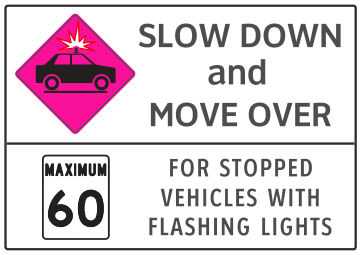 Slow down and move over
Road signs illustrated in “Emergency response vehicles and tow trucks”.
Emergency vehicles
Guide page 87
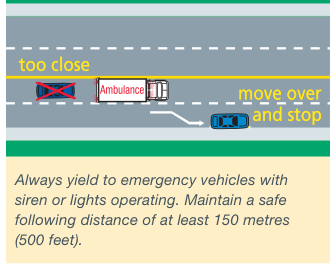
When an ambulance, fire, or police emergency vehicle is approaching from any direction and is sounding a siren, you must yield the right-of-way:
- Safely move your vehicle to allow the emergency vehicle passage.
- Drive as closely as possible to the right curb or edge of a two-way roadway.
- Move right or left to the nearest curb on one-way streets.
- Stop until the emergency vehicle has passed. Check that no other emergency vehicles are approaching. If you see a vehicle with flashing green lights, treat it like any other emergency vehicle. In some municipalities, volunteer fire fighters use flashing green lights on their emergency response vehicles when responding to a fire or other emergencies. Always yield to emergency vehicles with siren or lights operating. Maintain a safe following distance of at least 150 metres (500 feet).
Maintenance and construction vehicles
Guide page 88
Road maintenance and construction vehicles can be used or parked on any portion of the road. You will be given adequate warning in advance of such a vehicle. You are required to obey all traffic control devices and the directions of flag persons. Signs will be posted well before a construction zone warning you of a lane reduction, lane closure, or workers ahead. In the construction zones, motorists must observe the posted speed and obey the flag person. When workers are present, the fines for speeding in these areas will be doubled. People working Obey flag person Lane ends or narrows
Stopping your vehicle safely for
law enforcement
When a police officer is behind you, with the emergency lights flashing, you are required to move to a safe location to allow the police vehicle to pass or to stop safely behind your vehicle. On a two-way roadway, carefully and legally stop your vehicle in a safe location at the right edge of the roadway. On a one-way roadway, carefully and legally stop your vehicle in a safe location at the nearest edge of the roadway. Always ensure that there is enough room for the police vehicle to stop safely behind your vehicle. When a police vehicle stops behind your vehicle, to ensure your safety, the safety of your passengers, as well as the safety of the police officers, do the following:
1 Remain calm. After you have stopped your vehicle, ensure your transmission is in the PARK gear (automatic transmission) or NEUTRAL gear (manual transmission). Apply the park brake.
2 Remain in your vehicle. Locate and be prepared to provide your driver’s licence, vehicle registration, and vehicle insurance.
3 Wait for instructions from the police officer when they approach your vehicle. Be cooperative. Provide the documents requested by the police officer.
4 DO NOT move your vehicle until instructed by the police officer.
NOTES
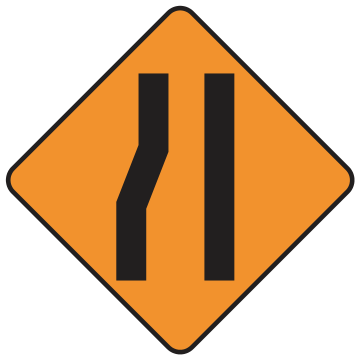 Lane ends or narrows
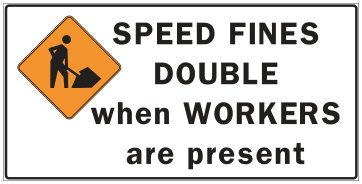 Speed fines double when workers are present
Road signs illustrated in “Maintenance and construction vehicles”.