Alberta Driver’s Guide · Chapter 7Français
Responsible Driving
This chapter covers proactive driving, securing passengers, fuel efficiency and helping our environment, traffic laws, scan all around your vehicle, watch for potential hazards, among other things.
4 sections
Proactive driving
Guide page 91
Proactive driving is driving with the aim to anticipate possible hazards and take action to reduce, minimize, or avoid danger before it can occur. Never assume other drivers are going to drive carefully or respond correctly. Anticipating what might happen can help you to avoid collisions caused by the driving errors of others. This chapter describes skills and techniques for driving proactively.
Scan all around your vehicle
Most of your attention should be given to looking forward and scanning for hazards that are developing ahead of you. When you are driving in an urban area, look at least 12 to 15 seconds ahead of your vehicle. This is about one to one-and-a- half blocks. When you are driving in rural areas, look at least 20 to 25 seconds ahead of your vehicle. This is your visual lead time, which provides you with time to respond to hazards ahead of you. Check behind you by glancing in your rear view mirrors every eight to 12 seconds (about every block in an urban area). Glance in your rear view mirrors when you anticipate slowing or stopping. Be aware of vehicles on both sides and in your blind spots. Do not forget to glance at your speedometer to check your speed.
Watch for potential hazards
Proactive driving involves a continuous process of watching your surroundings and thinking about whether hazards are developing, and then taking action to reduce risks. Watch for hazards that are fixed (those that do not change) and hazards that are variable (those that change). Fixed hazards are permanent conditions and situations along the roadway, including:
- restricted vision areas such as curves, hills, and hidden driveways
- intersections
- merging roadways. Variable hazards change through the day, including:
- school children and other pedestrians
- left-turning vehicles
- icy road surfaces
- “stale” green lights
- emergency vehicles. Be prepared to take action to avoid a problem as the situation changes. Expect the unexpected and always plan an escape route.
Have a space cushion
Leave enough space between yourself and the vehicles ahead, behind, and to either side, to stop safely or steer around a possible hazard. If someone is following too closely, and if it is safe, reduce your speed just enough to encourage them to pass. If the person does not pass, create a wider space cushion between you and the vehicle ahead. When stopping behind another vehicle in traffic, leave enough space so that you could move your vehicle into another lane without having to reverse. The extra space reduces the risk of hitting the vehicle ahead if you are hit from behind. This also allows you to move out of the way of a vehicle that may be skidding or slipping on ice behind you.
Plan ahead
Plan your travel route before you set out, and keep it in mind as you drive. Be sure you are in the proper lane well in advance of your exit or turning location. This will help you avoid making quick and dangerous lane changes. If you miss your exit or turn, continue on to the next exit or intersection. Never drive your vehicle in reverse on a roadway to return to a missed exit or turn. Use your signal lights to let other drivers know what you intend to do.
Collision avoidance
Watch the road ahead and stay alert. Watch for any possible problems. If you must turn sharply to avoid something in your lane, stay on your side of the yellow line if possible. You can learn more about proactive driving and avoiding a collision by taking an approved driver education course. Defensive Driving Courses are available throughout the province from licensed driver training schools and authorized agencies. Keep a minimum two second distance when following another vehicle.
Maintain your following
time and distance
Under normal road and weather conditions you should drive a minimum of two seconds behind the vehicle ahead. When conditions are less than ideal, increase your following distance. To know if you are two seconds behind the vehicle in front of you, when it passes a fixed objects such as a road marking or a shadow on the roadway, start counting. Count one-thousand-and-one, one- thousand-and-two. If the front of your vehicle reaches the object before you are finished counting, you are following too closely. Reduce your speed and count once more. The two second rule works at any speed. An exception to this rule is for drivers of large vehicles, such as motor homes. It is recommended that you use a minimum four second following distance.
Cellular phones and
other distractions
Do not use a cellular phone or other electronic devices while driving. Using a cellular phone to make or receive a call, or to receive or send a text message, is a distraction that can take your attention away from the demanding task of driving. This applies to hands-free cellular telephones as well. If you want to make or receive a call, or receive or send a text message, stop in a safe and legal place. Do not engage in activities that allow you to be distracted while driving. While all forms of distracted driving can be hazardous, the Traffic Safety Act includes fines and three demerits for certain distractions. These include:
- using a hand-held cell phone
- texting or e-mailing
- using electronic devices, such as laptop computers, video games, cameras, and video entertainment displays
- programming portable audio players
- entering information on GPS units
- reading printed materials in the vehicle
- writing, printing, or sketching
- personal grooming.
Securing passengers
Guide page 93
In Alberta, all drivers and passengers must be properly secured in the vehicle with a seat belt or an approved child safety seat attached by a seat belt or an anchor system. Passengers 16 years of age and older not properly secured in the vehicle can be fined. As the driver, you are responsible for ensuring that all passengers in your vehicle under 16 years of age are properly secured. You can be fined if they are not properly secured.
Child safety seats
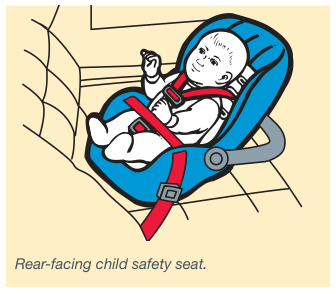
A child under the age of six years and who does not weigh more than 18 kilograms (40 pounds) must be properly secured in a child safety seat. The child safety seat must be installed in the vehicle according to manufacturer’s instructions of the vehicle and child safety seat. All child safety seats used in Canada must have a label on them that states the product meets Canada Motor Vehicle Safety Standard 213. Do not use a child safety seat unless it has this label. Do not use a child safety seat that is designed for use in countries other than Canada. There are various types of child safety seats available. Choose one that is right for your child’s age or weight. Rear facing safety seats: From birth, all children must ride in either a rear-facing infant seat or a rear-facing convertible seat until reaching the recommended weight to switch to a forward facing safety seat, according to the manufacturer’s instructions. All newer vehicles and child safety seats come equipped with the universal anchor system or UAS/LATCH. In older vehicles, the child safety seat must be properly secured into the vehicle using the seat belt. Check the instruction manuals for your vehicle and the child safety seat for more information. Rear-facing child safety seat . Forward-facing safety seats: Forward-facing child safety seats are designed for children 10 to 18 kilograms (22 to 40 pounds). All newer vehicles and child safety seats come equipped with the universal anchor system or UAS/LATCH. In older vehicles, a forward-facing seat must be properly secured by using the vehicle seat belt. The child safety seat’s tether strap and vehicle’s tether anchor must be used. (You may need to have a tether anchor installed by your vehicle dealer.) Check the instruction manuals for the vehicle and child safety seat for more information. Convertible child safety seat UAS/LATCH with tether
Booster seats
Children who weigh more than
18 kilograms (40 pounds) should be secured in an approved booster seat prior to using only the vehicle’s seat belt without a booster seat. The seat must be used according to the manufacturer’s instructions. Examples of booster seats.
Fuel efficiency and helping our environment
Guide page 95
Improving fuel efficiency
Most drivers can significantly reduce the amount of fuel used by applying the following basic driving practices. When buying a vehicle, consider fuel- efficient models. Generally, the smaller the engine, the less fuel it will use. When shopping for a new vehicle, look for its EnerGuide label. This identifies the vehicle fuel usage in terms of litres used for each
100 kilometres driven (litres/100 km), and estimated annual fuel cost. Travelling at higher speeds increases fuel use. Every 10 km/h above 90 km/h burns about 10 per cent more fuel. Avoid quick acceleration. It is safer and more fuel-efficient to gradually increase your speed. As much as possible, maintain a steady speed. Rapid acceleration and changes in speed can increase fuel consumption by as much as
40 per cent. Cruise control can help maintain a fuel-efficient steady speed on the highway. Idling wastes fuel. Ten seconds of idling can consume more fuel than turning off your engine and re-starting it. If you are parking for more than 10 seconds, turn off your engine. For every 10 minutes of idling, the average vehicle uses about one-third of a litre of fuel. A vehicle with a larger engine can use up to one-half of a litre. Idling your engine is not the best way to warm your vehicle in the winter. Idling warms the engine and possibly the interior of the vehicle, but it does not warm vehicle parts such as the tires, steering, and other moving parts. These parts of your vehicle are only warmed by driving. According to Natural Resources Canada, one minute of idling on a cold winter day is enough. Use a block heater in the winter to warm the engine oil and make cold starts easier on your engine. Use a timer to switch the block heater on two hours before you plan to drive. Proper use of a block heater can improve your vehicle’s overall fuel economy by as much as 10 per cent. Do not leave your block heater on overnight or your energy savings will disappear in higher electricity costs. Remote vehicle starters are handy on cold mornings, but do not start your vehicle too early. Have regular maintenance checks done by a qualified mechanic. A vehicle that is properly maintained will be more fuel- efficient and safe:
- A poorly tuned engine can increase fuel consumption by up to 50 per cent.
- A clogged air filter can reduce fuel efficiency by 10 per cent.
- Under-inflated tires increase fuel consumption by about five per cent, as well as increase tire wear and reduce traction. To get maximum fuel economy on a vehicle with a manual transmission, shift through the lower gears smoothly and quickly. Build up speed in the higher gears. An automatic transmission shifts to a higher gear earlier if you reduce pressure on the gas pedal as you increase speed. You can improve your fuel efficiency in summer by minimizing your use of air conditioning. Air conditioners used in stop-and-go traffic can increase fuel consumption by as much as 10 to 25 per cent. At highway speeds, air conditioning increases fuel consumption by three to four per cent. To stay cool at highway speeds, use your vehicle’s flow through ventilation. When driving in the city, open a window. Extra weight means using extra fuel. Heavy bags of sand and salt in the trunk will help winter driving traction, but should be removed when no longer needed. Trip planning can save you time, money, and fuel. Avoid traffic congested routes. Combine several errands into one longer trip and avoid rush hour traffic when possible.
Fuelling safety
Fuelling a vehicle should receive your full attention:
- Do not smoke, light matches, or use a lighter when fuelling your vehicle. Gasoline vapours mix with air, which contains oxygen. If you add an ignition source such as cigarettes or matches, a fire or explosion can occur.
- Do not use a cellular phone while fuelling. Phones that light up when switched on or when they ring may have enough energy to provide a spark. The spark could ignite gasoline vapours.
- Turn your vehicle ignition off before fuelling.
- If you have a recreational vehicle (RV) or trailer, be sure that any pilot lights are turned off. These could provide a source of ignition.
- Inform the station attendant if there is a fuel spill.
- Do not let children handle the fuel nozzle. Do not expose your child to the potential risk of being splashed with gasoline or inhaling fumes.
- Never prop the fuel nozzle handle open with an object. This greatly increases the chance of spills.
- Stay by the nozzle handle during fuelling. Static electricity can be generated as you move around or get in and out of your vehicle. When you return to the pump and touch the nozzle handle, static electricity could be released. This could ignite the gasoline vapours and cause a fire or explosion.
- Do not overfill your tank. Overflow and spills can affect the environment.
- When filling extra containers, such as gas containers for your lawn mower or snow blower, remove them from your vehicle and place them on the ground. This will allow static electricity to discharge and keep spills out of your vehicle.
Traffic laws
Guide page 96
Some traffic laws that all drivers should be aware of include the following:
- Do not use your vehicle to tow anyone, for example, a person on skis, riding a toboggan, motorcycle, or bicycle.
- It is against the law to let a person ride in a trailer when it is being towed.
- People under the age of 14 cannot operate a tractor or any self-propelled farm equipment on a highway.
- If the view from your inside rear view mirror is blocked, you must attach an outside rear view mirror on each side of the vehicle.
- If a vehicle’s load extends one and a half metres (five feet) or more beyond the rear of the vehicle, the following is required: · During daylight hours, a red flag should be attached to the end of the extension or load. The flag must be at least 30 centimetres (one foot) long on each of the four sides of the square. · At night, a red light must be attached to the end of the extension or load.
- In a residential area, you must not operate a vehicle in a way that disturbs the residents between the hours of
10 p.m. and 7 a.m.
- If you drive a vehicle on a roadway without care and attention, or without reasonable consideration for others using the road, you could be found guilty of careless driving.
- It is illegal to operate your vehicle using two lanes on a highway, except when conditions cause the use of a single lane to be impractical.
- When you are driving, you must not allow anyone to ride on the outside of your vehicle. This includes the open box of a pick up truck. You and the other person can be charged for this offence.