Alberta Driver’s Guide · Chapter 5Français
Highways and Freeways
This chapter covers What is a weave zone?, entering and exiting a major roadway, blind spots, changing lanes, merging, curves, hills, weave zones, passing, among other things.
4 sections
What is a weave zone?
Guide page 72
Most major roadways and highways are divided into lanes, with lines on the road surface to indicate where your vehicle should travel and the rules of lane driving that you should follow. Choose the lane that best meets your needs for safety and getting to your destination. Plan ahead. Do not leave lane changes to the last minute. When a roadway has been divided into lanes by visible marking lines on the road surface, you should drive in the centre of your lane.
Blind spots
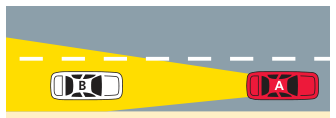
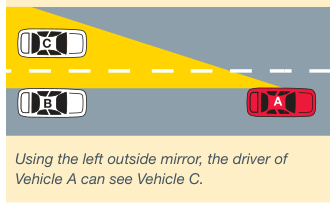
Your inside and outside rear view mirrors will show you the traffic that is behind your vehicle. They will not show you everything to the sides or what is right beside and slightly behind in the lanes next to you. These are blind spots. Using the inside rear view mirror, the driver of Vehicle A can see Vehicle B. Using the left outside mirror, the driver of Vehicle A can see Vehicle C. The view in your inside rear view mirror should show as much of the view through your rear window as possible. The outside rear view mirrors should show a little of your vehicle on the side where the mirror is attached, as well as the area behind you in the lane next to you. They should be positioned so that from your driving position you see the horizon behind you in the middle of each mirror. Be sure your inside and outside rear view mirrors are adjusted properly to minimize blind spots. The following pictures show what can be seen in properly adjusted mirrors. Using both outside mirrors and inside rear view mirror, the driver of Vehicle A can see Vehicles B, C, and D. The driver of Vehicle A cannot see Vehicles E and F, either in the mirrors or through peripheral (side) vision. Vehicles E and F are in Vehicle A’s blind spots. The red shading shows the blind spots for the driver of Vehicle A.
Changing lanes
To account for blind spots, you must do shoulder checks in addition to mirror checks before changing lanes. To shoulder check properly, quickly glance back over your shoulder through the rear side windows in the direction you intend to move. This allows you to see the area you are unable to see in your mirrors. If you do not have backseat side windows or a back rear window, you need to use your outside mirrors with an attached convex mirror. When moving from one lane to another, do the following:
- Be sure a lane change is permitted.
- Check for traffic by glancing in your inside and outside rear view mirrors.
- Check over your shoulder to be sure there are no vehicles or cyclists in your blind spots.
- Turn on the proper signal light.
- If safe, change lanes while maintaining your speed as much as possible.
- Ensure your signal light is turned off.
Passing
Guide page 73
Passing on a multi-lane
highway
On a multi-lane highway, slower traffic should use the travel lane furthest to the right (unless needing the left lane to turn left). This leaves the left lane available for other drivers to use for passing.
Passing lanes
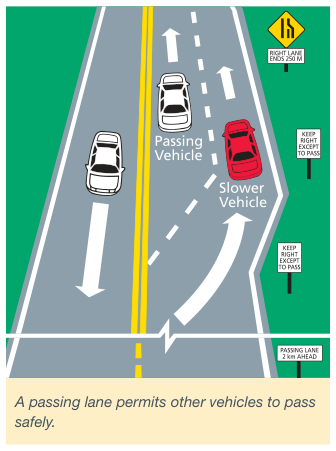
A passing lane is a lane added to a highway to allow passing, often in the mountains. Slower vehicles move into the passing lane to the right, permitting other vehicles to pass safely in the left lane. Signs will alert drivers to a passing lane ahead. A passing lane permits other vehicles to pass safely. When approaching the end of the passing lane, drivers in the right lane must merge safely with traffic to the left. Drivers in the left lane must cooperate to let drivers from the right lane merge. Signs are posted to alert drivers that the passing lane is ending.
Passing on a two-lane highway
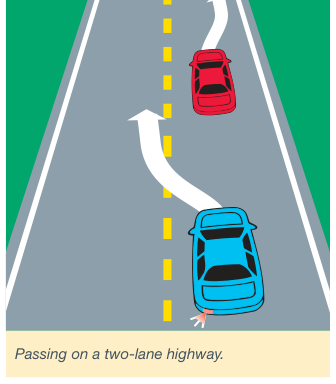
On a two-lane highway (one lane of traffic in each direction), passing another vehicle can be difficult and dangerous. Errors in judgement can result in head-on collisions, and these often cause fatalities. Passing should be done only where it is legal, when it is necessary, and with extreme caution. Before passing another vehicle on a two- lane road, do the following:
- Pass only where it is permitted.
- Keep a safe following distance behind the vehicle you intend to pass.
- Pass vehicles only when there is no oncoming traffic for a safe distance.
- Check your outside and inside rear view mirrors.
- Do a shoulder check to the left to look for vehicles that may be passing you on the left. These vehicles may be in your blind spot.
- Turn on your left signal light.
- Before you attempt to pass, check again that there is no oncoming traffic and that you can complete the pass while it is stlll permitted.
- It is illegal to exceed the speed limit when passing another vehicle.
- Once the vehicle you have passed is visible in your inside rear view mirror, do a shoulder check to the right.
- Turn on your right signal light.
- Return to your original lane while maintaining your speed.
- Ensure your signal light is turned off. Passing on a two-lane highway. When being passed on a two-lane highway, help the driver passing you by staying in your lane. Move to the right side of your lane to give the other driver a better view of the road ahead.
When is it illegal to pass
another vehicle?
Do not pass when:
- oncoming vehicles are too close. If you have any doubts about safely completing the pass, do not attempt to pass
- a solid yellow line is on your side of the centre line
- a sign indicates a no passing zone
- you are in a school or playground zone during school or playground zone times
- another vehicle is stopped to allow a pedestrian to cross at a marked or unmarked crosswalk
- a school bus has flashing red lights and the stop arm extended indicating the school bus has stopped. (It is not the safest choice to pass a school bus that has flashing amber lights, indicating that it is reducing speed, because it may be stopping to allow passengers on and off the school bus. If you do proceed, do it with caution.)
Emergency stopping lane
Guide page 74
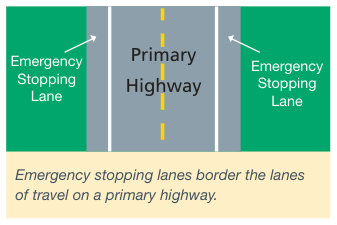
The portion of a primary highway that lies between the edge of the roadway and the first lane of travel, sometimes referred to as the shoulder, is for drivers who need to stop due to an urgent situation or because they have problems with their vehicle. Emergency stopping lanes border the lanes of travel on a primary highway. Do not drive in the emergency stopping lane of a highway. Do not pass or assist another vehicle to pass you by using this lane.
Entering and exiting a major roadway
Guide page 75
Merging
Merging is done when two roadways join into one and the traffic on the main roadway must cooperate to allow enough space for vehicles to enter from the merging lane. Neither the merging vehicle nor the vehicles already on the highway have the right-of-way. Merging is a shared responsibility between the vehicles joining the roadway and the vehicles already on the roadway. Avoid reducing your speed abruptly or stopping when merging. Merging lanes are designed to allow your vehicle to reach the posted speed limit of the road you are merging onto. The drivers behind you are expecting you to continue moving ahead. If you slow or stop your vehicle may be hit from behind. Some tips for merging safely:
- Merging requires that you plan and time your approach to blend smoothly with traffic, without stopping or abruptly reducing your speed.
- Check the traffic flow on the highway as soon as you can see the lane where you will be merging.
- Choose your gap in the traffic, and begin adjusting your speed, if required. Keep glancing at the gap you chose to ensure you are making the speed and timing adjustments necessary to safely merge without affecting traffic.
- Use your signal light before or when you are in the acceleration lane.
- Accelerate to the speed of the traffic on the main road.
- Keep shoulder checking to view the gap and look in your rear view mirror for vehicles following you.
- When it is safe and legal, move into the gap after you are past the solid white line of the acceleration lane. Maintain your speed at or near the speed of the other vehicles.
- Ensure your signal light is turned off. If you are on the main roadway, and traffic is merging, move left to the next lane if it is safe. This leaves the right travel lane clear for the merging vehicles to enter. Correct and incorrect method for merging. Correct (safe) and incorrect (unsafe) method for exiting from a highway.
Exiting
Some tips on how to exit a major roadway or highway safely:
- Plan ahead. Be in the proper lane well before you reach your exit.
- Use your turn signal well in advance of the exit to alert other drivers.
- Move into the deceleration lane if there is one.
- If possible, do most of the slowing in the deceleration lane. Some deceleration lanes are short; you may need to start to reduce your speed while still on the highway.
- When you have exited, ensure your signal light is turned off.
- If you miss your exit, do not stop. Continue to the next exit and make plans to return to your route. Do not stop and reverse on a highway, emergency stopping lane, or shoulder.
Weave zones
On some roadway interchanges, there are places where the highway entrance and exit use the same lane. The entrance and exit can be close together. These areas require caution and cooperation because vehicles share the same lane to slow to exit the highway while other vehicles are using it to increase speed to enter the highway. The area that these vehicles share is called a weave zone. In weave zones, control your speed and the timing of your lane change to merge with other traffic. This requires skillful use of time and space. Use caution in weave zones to ensure all vehicles can safely exit and enter the highway. Vehicles will cross paths in a weave zone.
Curves
Curves require special attention. To drive on curves safely, drivers should remember:
- If you need to reduce your speed, do it before entering the curve, and stay centred in your lane.
- To stay centred in your lane, look well ahead and around the curve. This will assist you with steering and speed control.
- Maintain a safe and steady speed after entering the curve.
- Do not pass vehicles on curves on highways with one lane in each direction. It is unsafe and illegal.
- Wet or icy roads can make curves slippery and increase the risk of danger while driving. The lines show where the drivers are looking to help them stay centred in their lanes . Due to kinetic energy, your vehicle will want to go straight ahead on a curve even though you are turning the wheels. If your tires lose traction with the road as you enter or travel around a curve to the left (Vehicle A in the above diagram), your vehicle may skid to the right side of the road. If this happens, stay off the accelerator and brake. If your tires lose traction with the road as you enter a curve to the right (Vehicle B in the above diagram), your vehicle may skid into oncoming traffic. If you skid in a curve, stay off the brake and the accelerator. Continue to look in the direction you want to go, and make small steering adjustments to come out of the skid.
Hills
Hills also require special attention. Remember the following when travelling up a hill:
- Use caution and move to the right in your lane as you approach the top of a hill. This may keep you from being hit by an oncoming vehicle that has crossed over the centre line and is in your lane.
- Do not pass near the top of a hill on a two-lane highway, as you cannot see what is ahead of you. Remember the following when travelling down a hill:
- If the hill is very steep, adjust your speed. The time it takes you to stop will increase when travelling down a hill.
- In a vehicle with a standard transmission, shifting to a lower gear can reduce the risk of your brakes overheating.