Alberta Driver’s Guide · Chapter 4Français
Intersections and Turns
This chapter covers right-of-way, intersections, right turns, left turns, dual lane turns, two-way left turn lanes, traffic circles and roundabouts, turning, u-turns, among other things.
8 sections
Right-of-way
Guide page 60
Collisions are possible where roadways meet and intersect. It is important to know who should proceed and who should stop to prevent collisions. Right-of-way rules require one person to yield and allow the other to proceed. Signs, signals, and sometimes the position of your vehicle to other vehicles at an intersection determine the rules. However, even if you have the right- of-way, you are still responsible to do everything you can to prevent a collision.
Intersections
Guide page 60
An intersection is where two or more roadways meet, creating a possible conflict between vehicles on those roads and with pedestrians crossing the roadways. These are high-risk locations for collisions. Intersections may be controlled by traffic signs, traffic signal lights, or both. Intersections not controlled by signs or signals are controlled by rules and regulations. To drive safely through controlled and uncontrolled intersections, you must know the rules and regulations that determine who has the right-of-way. Always be careful. Other drivers may not be paying attention to the signs and signals, or may be unaware of the rules at intersections without signs or signals. Note: For information about traffic signs and traffic signals, refer to Chapter 2. Directions given by a peace officer or police officer must be followed over traffic signs or signals.
Intersections controlled
by signs
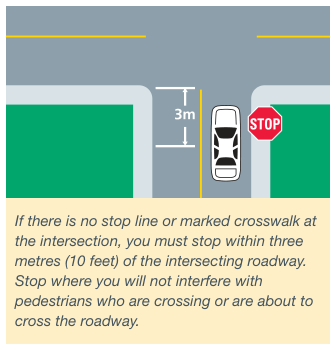
Stop signs: A stop sign indicates that your vehicle must come to a complete stop. After stopping, check the intersection carefully for pedestrians and other traffic. When safe, you may proceed. There are rules about where you must stop your vehicle when you come to a stop sign. Rules for stopping at intersections: Where a stop line has been marked, bring your vehicle to a complete stop before the stop line. Before moving forward, give pedestrians and traffic the right-of-way. Stop before the stop line at a marked crosswalk. Where there is no stop line, stop before the marked crosswalk. If there is no stop line or marked crosswalk at the intersection, you must stop within three metres (10 feet) of the intersecting roadway. Stop where you will not interfere with pedestrians who are crossing or are about to cross the roadway. Three- and four-way stop intersections, where stop signs are located at all corners, are sometimes referred to as “courtesy corners”. Vehicles approaching from each direction are required to stop. All drivers must use courtesy and caution. Courtesy is to allow the vehicle that arrived first to proceed first. If two vehicles arrive at the same time, courtesy allows the vehicle on the right to proceed first. You must not proceed unless you can do so safely. Yield signs: A yield sign means that you must allow other vehicles that do not face a yield sign the right-of-way to proceed. When approaching a yield sign, reduce speed as you near the intersection and be prepared to stop. You may be required to stop and yield the right-of-way to traffic or pedestrians. Wait for a safe gap in the traffic before proceeding. If there are no pedestrians or traffic that you are required to yield to, you may proceed through the intersection without coming to a complete stop. Your approach must be at a speed that allows you to stop easily to prevent a collision with another vehicle or person. Vehicle at yield sign allows other vehicle to pass.
Uncontrolled intersections
Guide page 61
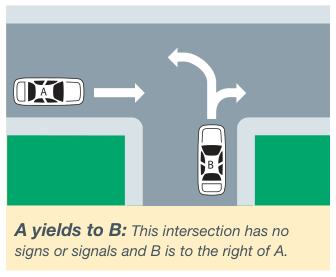
Some intersections have no traffic signs and no traffic signal lights. At these intersections, you must yield the right-of-way to a vehicle on your right. Check for traffic approaching from your left and right when you are approaching an intersection without a traffic control device. Similar to an intersection controlled by a stop sign, adjust your speed to the visibility and road conditions. Your view may be obstructed by fences, trees, or parked cars. You must reduce your speed enough to be able to stop your vehicle easily. When road conditions are slippery, reduce your speed to allow for the increased stopping distance. Use caution and judgement at all intersections without signs or signals. Even if you have the right-of-way, be sure the other vehicle is going to yield before you proceed. A yields to B: This intersection has no signs or signals and B is to the right of A. A yields to B: A would be crossing B’s path and neither is to the right of the other. When exiting from service roads, alleys, parking lots, and driveways, you must:
- stop before any sidewalk crossing
- stop before entering a main street
- yield to pedestrians. Intersection reminders:
- A driver turning left across the path of an approaching vehicle cannot turn left until it is safe.
- Parking lots have intersections without signs or signals, and the right-of-way rules apply.
- All intersections have crosswalks that may be marked or unmarked and you must not pass another vehicle that has stopped for a pedestrian. A yields to B: This intersection has no signs or signals and B is to the right of A. The T intersection without signs or signals (also known as an uncontrolled intersection) is a unique situation. There are no traffic control signs or signals, therefore the driver on the right (vehicle B) has the right-of-way. Be careful in this situation in case the driver going straight through (vehicle A) incorrectly assumes the right-of-way.
Keep intersections clear
Guide page 62
Do not enter an intersection until you are able to clear it completely. If traffic is delayed at an intersection, do not enter the intersection until you can completely clear the intersection and crosswalk on the other side. Vehicle A is in the proper location. Vehicle B has blocked the crosswalk. Vehicles C and D have used poor judgement and have had to stop in the intersection. Cross traffic has been affected. Ensure that there is enough space to allow your vehicle to completely clear the intersection and crosswalks before entering.
Traffic circles and roundabouts
Guide page 63
Traffic circles and roundabouts are circular intersections designed to improve traffic flow and safety. Traffic always circulates in a counterclockwise direction around a centre island. Vehicles entering the intersection must yield to traffic already in the circle. There are differences between traffic circles and roundabouts. The centre island of a roundabout is smaller than the centre island of a traffic circle. The roundabout has been designed with a tighter curve around the island to encourage lower speeds and may have a sloped curb to allow more room for larger commercial vehicles. Roundabouts can come in several different shapes and sizes. Drivers must watch for and obey traffic signs and or pavement markings. Pedestrian crossings on roundabouts are located away from the intersection for safety, as well as improved lines of sight for motorists and pedestrians. Drivers must follow similar rules when using roundabouts or traffic circles.
One-lane traffic circle /
roundabout
An example of a single-lane circular intersection. Entering circular intersections: Drivers entering a one-lane circular intersection must yield to drivers already in the circle. Once in the circle, drivers must activate the right signal when preparing to exit. Exiting circular intersections: Always wait to activate your right turn signal after passing the exit that is before your intended exit. This tells other drivers that you intend to leave the circle at the next exit. When you intend to exit at the first available exit:
- Use your right signal as you approach. Leave it on until you have exited the circle.
- As you approach, scan for pedestrians and cyclists at the crosswalks at the entrance and exits of the circle. When you intend to exit at any other exit:
- As you approach, scan for pedestrians and cyclists at the crosswalks at the entrance and exits of the circle.
- Activate your right signal when approaching the exit you wish to use.
Two-lane traffic circle /
roundabout
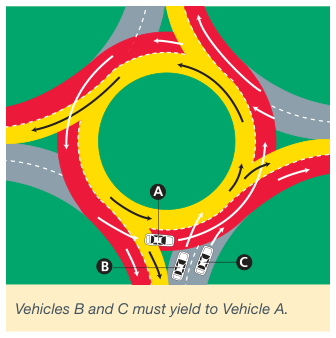
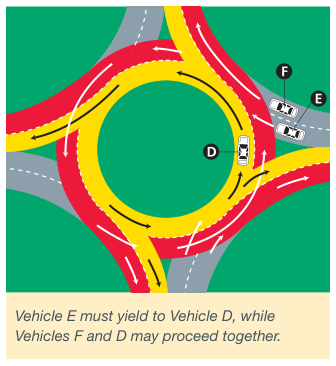
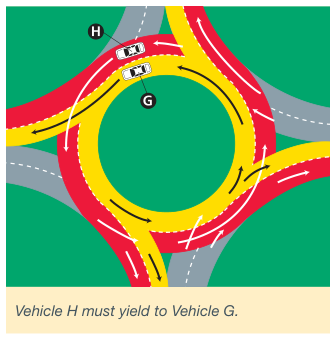
Entering circular intersections: Drivers entering the circular intersection must yield to drivers already in the circle. Once in the circle, drivers must activate the right signal when preparing to exit. Using the right lane to enter and exit: Drivers entering the circle from the right lane must do so when it is safe and stay in the right lane while in the circle. They must exit using the right lane. Using the left lane to enter and exit: Drivers using the left lane to enter the circle must do so when it is safe and stay in the left lane while in the circle/ roundabout. They must exit using the left lane. Drivers planning to travel past the first exit should use the left lane to enter and exit. In circular intersections: While in the circle, the drivers on the right must yield to the drivers on the left. Activate the right signal when preparing to exit. Use caution when exiting and crossing through the right (outside) lane. Do not change lanes in the circle. Traffic in the red lanes (white arrows) must yield to traffic in the yellow lanes (black arrows). Traffic entering the circle (grey lanes) must yield to traffic in the circle (red and yellow lanes). Vehicles B and C must yield to Vehicle A. Vehicle E must yield to Vehicle D, while Vehicles F and D may proceed together. Vehicle H must yield to Vehicle G. Exiting circular intersections: Always wait to activate your right turn signal after passing the exit that is before your intended exit. This tells other drivers that you intend to leave the circle at the next exit. When you intend to exit at the first available exit:
- Approach the circle using the right lane.
- Use your right signal as you approach. Leave it on until you have exited the circle.
- As you approach, scan for pedestrians and cyclists at the crosswalks at the entrance and exits of the circle.
- Yield to traffic in the circle.
- Exit the circle using the right lane. When you intend to leave at any other exit:
- Approach the circle using the left lane.
- Activate your left signal to communicate that you do not plan to use the first exit.
- As you approach, scan for pedestrians and cyclists at the crosswalks at the entrance and exits of the circle.
- Yield to traffic in the circle.
- Exit the circle using the left lane. Remember, when you exit using the left lane:
- Use your right signal when you pass the exit that is one before the exit you will use.
- Check for traffic in the right lane that may be continuing around the circle.
- Look ahead for pedestrians at the crosswalk where you will be exiting.
- Exit the circle using the left lane.
- If you cannot stop or exit safely, stay in your lane and travel around the circle/ roundabout again.
Turning
Guide page 65
Many collisions are caused by drivers who fail to turn safely.
Right turns
Remember that travel lanes are not always marked with lines on the road or signs. A travel lane is a section of roadway wide enough to allow the passage of a single line of vehicles. This includes a curb lane lined with parking meters. The lane next to the curb where vehicles park is best referred to as a curb lane, not a parking lane. Curb lanes are not just for parking. They are used to turn off a road and onto a road. Prepare for a turn well in advance. If you are not in the proper turning lane, check your rear view and outside mirrors and do a shoulder check. Signal and change lanes when it is safe. You should be in your proper turning lane at least 15 metres (50 feet) before the intersection. Remember to yield the right-of-way to pedestrians and vehicles on the cross street. Before turning, assess the street you are turning onto and determine if there is enough room to enter the curb lane. Check over your right shoulder for cyclists and pedestrians approaching the intersection. When making a right turn from a two-way road onto another two-way road, stay centred in the turning lane, not more than one metre (three feet) away from the curb or road’s edge. Maintain this distance as you approach the intersection, while turning, and as you leave it. Remember the following when turning:
- Yield to pedestrians crossing in the crosswalk.
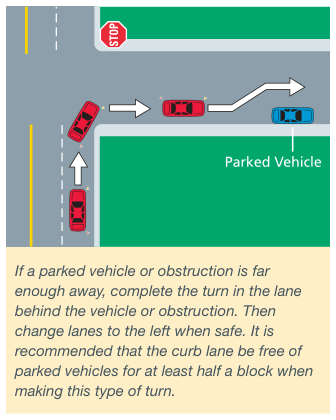
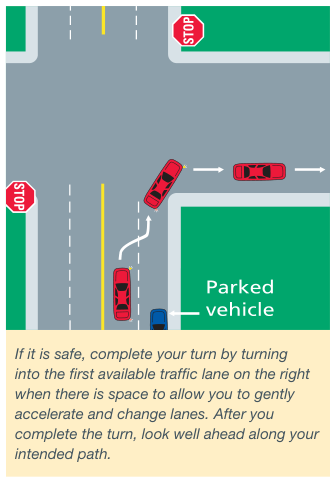
- Do not enter the crosswalk to turn until pedestrians are safely out of the intersection. If it is safe, complete your turn by turning into the first available traffic lane on the right when there is space to allow you to gently accelerate and change lanes. After you complete the turn, look well ahead along your intended path. If a parked vehicle or obstruction is far enough away, complete the turn in the lane behind the vehicle or obstruction. Then change lanes to the left when safe. It is recommended that the curb lane be free of parked vehicles for at least half a block when making this type of turn. Parked vehicle If the first lane on the street you are turning onto has a parked car or obstruction close to the corner, turn into the first available lane to the left of the parked vehicle. When the lane is clear, turn directly into it. Note: Yield to other vehicles approaching from your left that are travelling in the lane you will enter. Do not turn wide and occupy two lanes when turning. Unless prohibited by a sign, you may turn right on a red light after you come to a complete stop at the proper stopping point (stop line or crosswalk).
Left turns
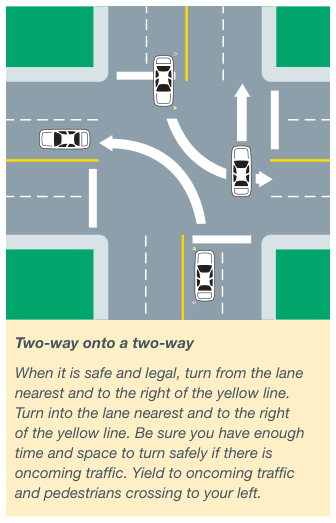
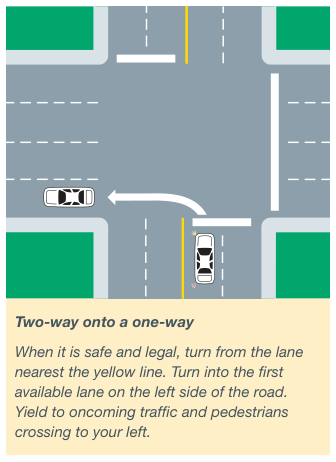
Poor judgement of time and space when turning left is a leading cause of collisions. Left turns can be dangerous because there may be vehicles approaching from multiple directions and your vehicle is crossing the lanes of oncoming traffic. Prepare well in advance. You should be in your proper turning lane at least 15 metres (50 feet) before the intersection. When turning from a two-way road onto another two-way road with a single left turn lane, drive in the lane to the right of the yellow line. Remain behind the crosswalk if there is only room for one vehicle ahead of your lane in the intersection. If it is legal to do so, enter the intersection when the vehicle ahead of you clears the intersection. If you must stop in the intersection prior to completing a left turn, stay to the right of the yellow line and keep your front wheels pointed straight ahead. Doing so prevents the vehicle from being pushed into oncoming traffic if you are hit from behind. Check the crosswalk of the road you are turning onto for pedestrians and cyclists. Look well along your intended path. When it is safe, turn the vehicle left at the intersection. Complete the turn by driving to the right side of the yellow line of the road you have entered. Do not turn wide and occupy two lanes when turning. Before turning left off a two-lane highway, do a shoulder check to the left to be sure you are not being passed by another vehicle on your left. Two-way onto a two-way When it is safe and legal, turn from the lane nearest and to the right of the yellow line. Turn into the lane nearest and to the right of the yellow line. Be sure you have enough time and space to turn safely if there is oncoming traffic. Yield to oncoming traffic and pedestrians crossing to your left. Two-way onto a one-way When it is safe and legal, turn from the lane nearest the yellow line. Turn into the first available lane on the left side of the road. Yield to oncoming traffic and pedestrians crossing to your left. One-way onto a two-way When it is safe and legal, turn from the lane nearest the left side of the road. Turn into the nearest lane to the right of the yellow line. Yield to pedestrians to your left. One-way onto a one-way When it is safe and legal, turn from the lane nearest the left side of the road. Turn into the lane nearest to the left side of the road. Yield to pedestrians crossing to your left. When the light is red, if there are no signs prohibiting turning, you may turn left from a one-way onto another one-way after coming to a complete stop at the proper stopping location (stop line or crosswalk) and the turn can be completed safely. This also applies to dual lane turns. Yield to pedestrians crossing to your left.
Turning lanes
Guide page 68
Some lanes are designated as turning lanes. As you approach an intersection, always check the signs and pavement markings. Make sure you are in the correct lane to turn or go straight ahead.
Dual lane turns
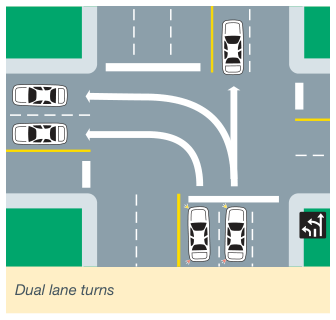
When turning right or left where dual lane turns are indicated by pavement markings or signs, approach the intersection in one of the marked lanes and turn into the corresponding lane. Dual lane turns Dual lane turns can only be made where indicated. Never swing wide or change lanes in dual lane turn intersections as another vehicle could be turning beside you. Watch the vehicle turning beside you, as it may swing wide into your lane. Unless prohibited by a sign, you may turn right on a red light at a dual right turn intersection after coming to a complete stop at the proper stopping point (stop line or crosswalk) and the turn can be completed safely. After completing a turn, dual turn lanes may converge into one lane. The driver in the lane that ends must change to the available lane by following the proper steps for a lane change.
Two-way left turn lanes
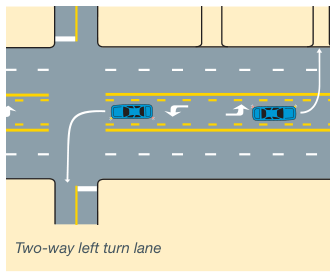
A two-way left turn lane allows vehicles from each direction to turn left using the same lane. Vehicles from both directions share this centre lane to turn left. It is permissible to cross the solid yellow line to enter the shared turn lane. Only enter the turning lane close to where you will be turning. Watch for oncoming vehicles in your lane. Two-way left turn lane Reminders for safe turning:
- Check for traffic, do a shoulder check, signal, and when safe, move into the proper lane.
- Signal with enough time to provide a reasonable warning to other drivers and pedestrians of your intention.
- Check oncoming and cross traffic as well as the crosswalk to your left for pedestrians. Watch for both vehicle and pedestrian traffic.
U-turns
Guide page 69
A U-turn is done by turning your vehicle around at an intersection to go in the opposite direction by using oncoming lanes. This sign means U-turns are not allowed. Do not do a U-turn unless it can be done safely. U-turns are not permitted:
- at an intersection controlled by a traffic control signal (traffic lights) unless permitted by a traffic control device
- where a sign prohibits U-turns. In urban areas U-turns are not permitted:
- on a roadway between intersections
- at an alley intersection
- at an intersection where one or more of the roadways is an access to a public or private parking lot which the public can access. Outside urban areas (rural) U-turns are not permitted:
- on a curve
- on an approach to or near the crest of a hill where the driver of another vehicle cannot see you that is within
150 metres approaching from either direction.