Alberta Driver’s Guide · Chapter 8Français
Sharing the Road
This chapter covers vulnerable road users, commercial vehicles, log hauling vehicles, railway crossings, vehicles carrying passengers or dangerous goods, funeral processions, among other things.
10 sections · 2 signs illustrated
Vulnerable road users
Guide page 99
Pedestrians, cyclists, and motorcycle riders also share the roadways with all vehicle operators on a daily basis. These road users have less protection than drivers of other types of vehicles. Be cautious when operating your vehicle around pedestrians, cyclists, and motorcycle riders.
Pedestrian safety
When you see a yellow flashing pedestrian-activated traffic light, slow to
30 km/h and yield to pedestrians wanting to cross the street.
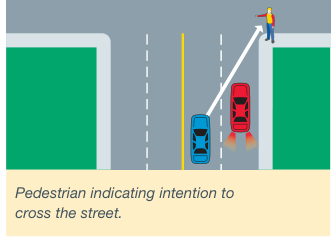
- In an urban area, pedestrians may indicate their intention to cross a street by raising an arm at a right angle and pointing to the opposite curb. Pedestrian indicating intention to cross the street.
- When pedestrians indicate their intention to cross the street, you must stop your vehicle safely before the crosswalk and allow them to cross.
- When a pedestrian has entered a marked or unmarked crosswalk, you must yield the right-of-way.
- When stopping for a pedestrian at a crosswalk, stop far enough back (about two to three car lengths) so that traffic in other lanes will be able to see the pedestrian and have time to stop.
- Never pass another vehicle when you are approaching a crosswalk. There is always a chance that the other vehicle is slowing or stopping for a pedestrian.
- Not all crosswalks are marked, but the rules of pedestrian safety should be followed at all intersections.
- Be considerate of visually impaired pedestrians. Some will have a white cane or guide dog.
- At night, do not overdrive your headlights. This means you should drive so you are able to stop your vehicle within the distance you can clearly see with your headlights.
- When it is dark, be alert for pedestrians. They can be difficult to see from a distance, especially if they are wearing dark clothing.
- Children can be unpredictable. In residential areas, watch for children around parked vehicles, riding bikes, or playing on the street. Glance under parked vehicles ahead on both sides of the road to check for children’s feet, toys, and bicycle wheels. These provide warning that you may need to stop.
Bicycles
The law requires cyclists or passengers on a bicycle, who are under 18 years of age, to wear an approved bicycle safety helmet. Tips for sharing the road with cyclists:
- A cyclist who is walking beside and pushing a bicycle is a pedestrian.
- Cyclists are required to ride as close as practicable to the right curb. However, they may need to ride further out when avoiding drainage grates, pot holes, debris, gravel or sand, wet or slippery surfaces, and rutted or grooved pavement. Be aware of the roadway conditions that may affect a cyclist.
- A bicycle that is being ridden is a vehicle. A cyclist must follow the rules of the road like drivers of other vehicles. · A cyclist seated on a bicycle at an intersection, waiting for a traffic control signal, has the same rights and responsibilities as any other vehicle waiting to proceed. · Cyclists are required to use the proper lane when turning left. A bicycle and rider are smaller than other vehicles, are less visible, and more exposed to traffic on left turns. Cyclists need extra consideration when turning left, especially on multi-lane roads.
- When passing a cyclist, change lanes such as you would for other vehicles.
- When you are preparing to turn right, watch for cyclists who may ride along side your vehicle. Remember to do a shoulder check to your blind spots to the right.
- When parked at the curb, always check for cyclists before you open your vehicle door. It is the driver’s responsibility to wait until it is safe before opening the door.
- Before moving away from the curb, check for cyclists who may be riding past your vehicle.
- Do not follow too closely behind cyclists. They do not have brake lights to warn you when they are stopping.
- Be alert for children on bicycles. They may lack the necessary knowledge and skills for safe cycling around traffic, and may not be aware of all the dangers. Children on oversized bicycles are at risk of losing control. Cyclists using the streets and highways should do the following:
- Keep both hands on the hand grips except when hand signalling.
- Keep both feet on the pedals.
- Only carry the number of people the bicycle is designed to carry.
- Never hold onto or attach the bicycle to any other moving vehicle.
- Ride single file except when passing another bicycle.
- For cycling after dark, equip the bicycle with at least one headlamp (but not more than two), one red tail lamp, and at least one red reflector mounted on the rear of the bicycle. Wear bright and reflective clothing.
- Be sure the bicycle has brakes that work well.
- Be sure that the bicycle is equipped with a bell or horn.
Motorcycles
Motorcycle riders often travel in the left portion of their lane. This helps make them more visible to other road users. It does not mean they will be turning left. Sometimes a motorcycle’s turn signals can be hard to see. Watch the rider for clues. If the rider does a shoulder check, they may be intending to change lanes or turn. When turning left, watch for oncoming motorcycles. They can be hard to see, especially in heavy traffic, at night, or at dusk. It may also be difficult to judge the speed of the motorcycle. Tips for driving safely with motorcycle riders:
- Never share a lane with a motorcycle rider. A motorcycle rider needs the whole lane to travel safely.
- Be aware that motorcycle riders will often move within their lane to avoid road hazards, such as pot holes, and to maintain a space cushion from other vehicles.
- When you are following someone riding a motorcycle, allow extra space between your vehicle and the motorcycle because motorcycles can stop very quickly.
- Be aware that poor weather, road conditions, or road hazards could make the motorcycle rider lose control.
Commercial vehicles
Guide page 101
Being aware of large vehicles is crucial for the safety of all road users. Follow these tips to ensure safe driving when sharing the road with large vehicles:
- Keep adequate space between you and large vehicles.
- When you are behind a large vehicle, increase your following time and distance so your viewing area will be larger.
- Never move into the space in front of a large vehicle that is approaching a traffic light. If the traffic light changes to red the driver needs that extra space for stopping. Moving too close to their vehicle may not give them enough room to brake and could cause a dangerous situation. Remember that a large vehicle needs extra distance to stop.
- If you are on a hill and stopping behind a large vehicle, leave extra space in front of your vehicle. The large vehicle may roll back when the driver releases their brakes.
- Large vehicles can spray debris, such as rocks, onto your windshield. Stay well back to avoid damage.
- Be cautious around a large vehicle that is backing. If you are too close behind, the driver may not be able to see you in the rear view mirrors.
- Larger vehicles have larger blind spots. If you are driving behind a large vehicle and cannot see both of its side mirrors, you are too close. If you can see the driver in the side mirror, then the driver can see you.
- You will need more time in the oncoming lane when passing a large vehicle. Do not pass unless you are sure that you have enough time and distance to complete the pass safely. Some large vehicles are long and may pull more than one trailer.
- Heavy commercial vehicles will require more distance to slow or stop. After passing one, leave extra room before you return to your lane in front of it. This also applies to changing lanes in front of one.
- Heavy commercial vehicles require extra room to turn. When a large vehicle is turning to the right, stay well back and do not drive in the space on the right of the large vehicle. Your vehicle could be squeezed between the large vehicle and the curb or edge of the road.
- If you are on a road that a large vehicle is turning onto, be aware that the operator of the vehicle may need to drive across the centre line, cut a corner, or use part of your lane to complete the turn. Stop back from the intersection to allow the operator the space to complete the turn.
- Large vehicles can create strong gusts of wind when passing, especially when there is a strong wind crossing the road. This may affect your ability to control your vehicle and maintain your lane position.
- Drivers must use caution when approaching and passing oversized vehicle loads. Some oversized vehicle loads travel in a convoy with pilot vehicles to the front and rear of the convoy. Oversized vehicle loads often travel at a reduced speed. Drivers of oversized vehicle loads and convoys typically look for opportunities to allow traffic to pass. If traffic buildup behind the oversized vehicle load or convoy becomes heavy, the entire unit will typically move off the travelled portion of the roadway to allow traffic to pass safely. Drivers who wish to pass oversized vehicle loads or convoys should ensure it is safe to do so by making sure they have enough room to manoeuver around the oversized vehicle load or convoy, and that they have an adequate sightline to ensure there is no oncoming traffic.
Log hauling vehicles
Guide page 102
Log hauling vehicles are long and heavy when loaded.
- Never pass a log hauling truck that is turning left or right off the highway. The extension of the logs from the rear of the truck may be as long as nine metres (30 feet). When these trucks are turning, the logs can block all or some of the lanes of the highway. Log hauling trucks may require all lanes of the highway when turning.
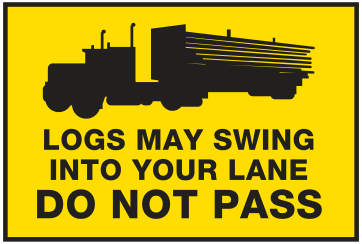 Logs may swing into your lane — do not pass
Road signs illustrated in “Log hauling vehicles”.
School buses
Guide page 103
Students using a school bus can be at risk when getting on or off the bus. When school bus lights are flashing: On an undivided highway (not divided by a median), do the following:
- When you approach a school bus from either direction (from the front or the rear), and it has the alternating amber lights flashing, you must be ready to stop. This is a warning that the alternating red lights are going to begin flashing and the school bus is stopping to allow students to get on or off.
STOP
approx. 20 metres On a two-lane undivided highway, both lanes must stop for a school bus.
STOP
approx. 20 metres On a four-lane undivided highway, all four lanes must stop for a school bus. MAY PROCEED WATCH FOR PEDESTRIANS On a highway divided by a median, vehicles to the rear of the school bus must stop.
- If you pass a school bus that has its alternating amber lights flashing, pass with caution.
- When the school bus stops to let students on or off, its alternating red lights will begin flashing. You will also see a stop sign extended from the left side of the school bus. You must come to a full stop about 20 metres (about four to five car lengths) away from the school bus. This distance allows drivers of other vehicles behind you to see the flashing lights and students crossing the highway. approx. 20 metres
STOP
SCHOOL BUS approx. 20 metres SCHOOL BUS
STOP
approx. 20 metres SCHOOL BUS
STOP
Median
- You must remain stopped until the alternating flashing red lights are turned off and the stop sign on the driver’s side is no longer extended. On a highway divided by a median, do the following:
- When you approach a school bus from the rear and its alternating amber lights are flashing, follow the same procedures as you would for a highway that is not divided by a median.
- When you approach a school bus from the front and the school bus has its alternating amber or red lights flashing, you may proceed with caution. Watch for pedestrians. Remember, this is only on a divided highway. These rules apply whenever and wherever the school bus lights are activated. Some municipalities have rules for school bus operation specific to their region.
Snowplows
Guide page 104
When clearing snow from the roads, snowplows may create a snow cloud that makes it difficult for drivers of other vehicles to see them. It may also be difficult to see past the snowplows for oncoming vehicles. Safety tips when driving near a snowplow:
- Snowplows are equipped with flashing amber and red lights to make them more visible. Remember, “flashing amber and red means snowplow ahead”.
- Maintain a safe following distance behind the snowplow. Most maintenance vehicles will have a sign at the rear to let motorists know the minimum safe following distance. Keeping this distance will give you more time to react to the unexpected, and avoid rock damage to your vehicle from the snowplow’s sanding unit.
- Passing a snowplow is strictly prohibited when: · the view along the side of the snowplow is obstructed · passing impedes the operation of the snowplow, or · the act of passing cannot be done safely.
- Snow plow operators will move to the side of the road, where it is safe, every five to eight kilometres to allow vehicles to pass. Even when passing is permitted, it is safer to stay well back until the snowplow operator can safely move over to allow vehicles to pass.
- Before passing a snowplow on a two-lane highway (one lane in each direction), be sure you can see far enough ahead and that passing is permitted by the road markings or signs. When a snowplow is approaching from the opposite direction, look ahead in your lane carefully. There may be an oncoming vehicle that is passing the snowplow using your lane. Be prepared to use an escape route.
Railway crossings
Guide page 105
Never try to outrace a train to a crossing. Trains need a very long distance to come to a stop. Always yield to them. Railway crossings are marked with signs. They can also have mechanical or electrical warning devices. Advance warning signs: These signs tell you to look, listen, and reduce speed because you may have to stop for a train. The speed sign below the advance warning sign is the recommended speed for the railway crossing. It will be less than the posted speed for the road. Pavement markings: Pavement markings, such as an X and/or stop line, may be marked on the pavement at the approach to some railway crossings. If you must stop for a train, do it before the stop line. Railway crossing signs: These signs are found at all public railway crossings. A railway crossing sign means drivers must yield to all trains. If there is more than one railway track, the crossing sign will show the number of tracks. You must stop when a train is visible or sounding a signal and approaching within 500 metres (about five city blocks) of the crossing. Railway crossing signs with a stop sign: A stop sign at a railway crossing requires the driver to come to a complete stop between five metres (15 feet) and
15 metres (50 feet) from the nearest rail. Do not proceed until you are sure a train is not approaching. Flashing red light signals and bell: Red light signals are used with railway signs at many railway crossings. Stop when the lights begin to flash and the bells ring to indicate a train is approaching. The driver of the vehicle nearest the crossing must stop at least five metres back from the nearest rail. Do not proceed until the lights and bells have stopped, and the train has passed or has come to a complete stop. If there is more than one track, be sure all tracks are clear before crossing. Gates (arms), lights, and bells: Gates are used with red light signals and bells at some railway crossings. You must remain stopped until the gates are raised, the lights stop flashing, and the bells stop ringing. Follow these safety tips when driving near railway tracks:
- Do not get trapped on the railway tracks at a railway crossing. Wait on the approach to the crossing and cross only when you are sure you can clear the crossing.
- When the last car of a train passes the crossing, make sure that another train is not coming before you move ahead. A second train can come on another track from a different direction. You may not be able to hear the second train because of the noise of the first one.
- Never drive around the gates. If the gate is down, is raising, or is lowering, do not cross the tracks.
- If your vehicle has a standard (manual) transmission, do not change gears while crossing the tracks. If you cannot complete the shift, your vehicle could be stalled on the tracks.
- If your vehicle stalls on a railway crossing, get everyone out of the vehicle and away from the track immediately. If a train is coming, move well away from your vehicle and away from the tracks. If possible, go in the direction where the train is approaching. This will prevent you from being hit with flying debris if the train hits the stalled vehicle.
- During poor weather or at night, be alert for advance railway warning and railway signs. Drive at a speed that will allow you to be able to stop within the distance clearly lit by your headlights. Remember, it may take a kilometre or more for a train to stop, even under full emergency braking. The safety of you and your passengers depends entirely on you as the driver.
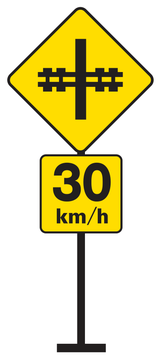 Railway crossing ahead
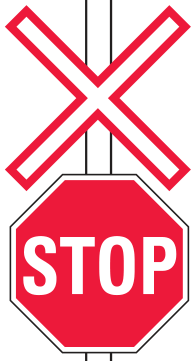 Stop at railway crossing
Road signs illustrated in “Railway crossings”.
Vehicles carrying passengers or dangerous goods
Guide page 107
Commercial vehicles transporting passengers or dangerous goods can be required by law or company policy to stop at railway crossings. Be prepared to stop when you are following a commercial vehicle near a railway crossing.
Light rail transit
Guide page 107
Light rail transit (LRT) crossings in Calgary and Edmonton are similar to other railway crossings and require pedestrians, cyclists, and motorists to use caution in these locations. LRT systems are powered by electricity, which makes them very quiet. These crossings use a variety of warning devices such as regular traffic signal lights, signs, bells, and gates. These warnings all mean stop and do not cross the tracks. Never drive around the gates, even if an LRT train has just passed. Another one may be coming from the other direction. Due to its weight and speed, an LRT train may take up to 100 metres (330 feet) to stop in an emergency.
Off-highway vehicles
Guide page 107
When driving, it is important to be aware of off-highway vehicles and their operators who may be near or attempting to cross the highway. Be cautious when encountering all-terrain vehicles, snowmobiles, or similar vehicles.
Funeral processions
Guide page 107
If you are participating in a funeral procession, you are permitted to continue through an intersection with a stop sign or red traffic light without stopping. Your headlights must be turned on. You may only proceed if you are closely following the vehicle in front of you in the procession and it is safe to do so. Do not pass through a funeral procession. Yield the right-of-way until it has passed before proceeding.