Alberta Driver’s Guide · Chapter 1Français
Licensing Information
This chapter covers graduated driver licensing, vision requirements, types of vehicles for licence class, for hire, driver’s licence requirements, air brake endorsement (q), among other things.
19 sections
Graduated driver licensing
Guide page 12
Regardless of age, all new drivers are part of the Graduated Driver Licensing (GDL) program. This program ensures new drivers get the support, skills, and experience they need to handle the complex task of driving. GDL improves road safety by creating a safe and controlled environment for all new drivers. As a GDL driver, you will hold one of the following driver’s licences:
- Stage One: Class 7 (Learner’s Licence)
- Stage Two: Class 5-GDL (Probationary Licence) The following information highlights the key features of the Learner and Probationary stages of the GDL program.
Stage 1: Learner (Class 7)
To obtain a Class 7 learner’s licence you must: be 14 years of age or older pass a vision screening pass a knowledge test on the rules of the road have parental consent if you are under 18 years of age have valid identification. Learner’s conditions:
- You must hold a learner’s licence (Class 7) for at least one year.
- You must be accompanied by a fully- licensed (non-GDL) driver who is 18 years of age or older and is seated next to you.
- You are not permitted to drive from midnight to 5 a.m.
- You are not permitted to have more passengers than seat belts.
- You will be suspended if you accumulate eight or more demerit points.
- You must have a zero alcohol and/ or drug level when driving (or riding a motorcycle).
Stage 2: GDL Probationary
(Class 5-GDL)
To become a probationary driver you must: hold your Class 7 leaner’s licence for a year (this time will be extended if you receive a suspension of your driving privileges) be 16 years of age or older pass the Alberta Class 5 road test. Probationary conditions:
- You must be a probationary driver for a minimum of two years.
- You must have no more passengers than seat belts.
- You will be suspended if you accumulate eight or more demerit points.
- You must have a zero alcohol and/or drug level when driving.
- You are not able to re-class your licence to a commercial driver’s licence (Class 1, 2, 3, or 4).
- You cannot serve as a supervising driver to a learner.
Stage 3: Full Class 5
(non-GDL)
To exit the GDL program you must: be at least 18 years of age be in the probationary stage for a minimum of two years be free of suspensions or traffic violations within the last 12 months of the probationary stage, including zero alcohol and/or drug level when driving. You can reduce your probationary stage by up to six months, if:
- you successfully complete an approved driver training course resulting in a condition code (U) being added to your driving record
- all other eligibility requirements are met. Upon exiting the GDL program, you will:
- move from a Class 5-GDL to a full Class 5 driver’s licence
- qualify to re-class to a Class 1, 2, 3, or
4 driver’s licence
- increase the number of demerits you are allowed
- remove the zero alcohol and drug tolerance condition
- be able to be an accompanying driver to a learner.
Knowledge test
Guide page 13
To obtain your learner’s licence, you will need to pass a knowledge test. You can take your knowledge test at most Alberta registry agent offices. The test is based on questions taken from this guide. You will be asked about safe driving practices, driving laws, and road signs. The test is a series of multiple choice questions and you must score a certain number of correct responses to pass the test. You will do the test on a computer. When you pass the knowledge test you must take the knowledge test permit you purchased to do the test to a registry agent to ensure your driver’s licence is updated. The Class 7 electronic driver knowledge test is available in the following 25 languages:
- Amharic
- Portuguese
- Arabic
- Punjabi
- Chinese (Simplified)
- Russian
- Chinese (Traditional)
- Somali
- Cree
- Spanish
- Dutch
- Tagalog
- English
- Thai
- Farsi
- Ukrainian
- French
- Urdu
- German
- Vietnamese
- Hindi
- Italian
- Korean
- Oromo
- Polish There is a fee for each knowledge test that you take, and you can take only one test per day.
Vision requirements
Guide page 14
A vision assessment is required before you are eligible to obtain an Alberta driver’s licence. If you do not meet the vision standards, you will be referred to an optometrist or an ophthalmologist to have a Vision Referral form completed. If you have corrective glasses or contact lenses, bring them with you for your vision assessment.
Class 5 road test
Guide page 14
Class 5 is the most commonly held driver’s licence, allowing drivers to operate cars and other light vehicles. Passing the Class 5 road test allows drivers to move from a Class 7 learner’s licence to a Class 5-GDL driver’s licence. This test determines whether a learner has developed the necessary driving skills such as safe vehicle handling, judgement, and knowledge of the rules of the road to become a Class 5-GDL probationary driver. When you pass the Class 5 road test you must take the road test permit you purchased to do the test to a registry agent to ensure your driver’s licence is updated. The road test permit is not a driver’s licence. This road test is approximately
45 minutes. This will include the driver examiner’s pre-test instructions and summary of your results. You will be required to demonstrate the ability to operate your vehicle safely without supervision while interacting with other road users. The vehicle for your road test must be in acceptable working condition and must have the following:
- a valid licence plate and insurance
- headlights, brake lights, and signal lights
- horn
- speedometer
- brakes/park brake
- unobstructed windshield/wipers
- tires are in good condition
- driver and passenger doors
- vehicle seats/seat belts
- exhaust system/muffler
- mirrors
- enough fuel for a road test. The test will include identifying and operating your vehicle’s controls. This includes:
- handling the vehicle (steering, braking, and speed control)
- selecting the proper lane for turns
- observing and obeying speed zones
- determining right-of-way at intersections and while changing lanes
- demonstrating knowledge and skill at intersections with and without sign and signal controls
- interacting with other road users in a non-obstructive manner
- parking – perpendicular, uphill, or downhill parking, and parallel (drivers over 65 are not required to complete a parallel park).
Some common reasons for not
passing the road test
Drivers earn points for mistakes made during a road test, with a set limit for each test. If the maximum points for errors are exceeded, the driver fails the test. Regardless of point totals, the following actions result in automatic failure:
- Exceeding the speed limit or driving too fast for the conditions.
- Failing to stop completely before proceeding through an intersection controlled by a stop sign, or before turning right on a red light.
- Failing to yield the right-of-way at an intersection or during a lane change.
- Obstructing traffic by driving too slowly or stopping unnecessarily.
- Climbing over the curb while parking, or being unable to park legally in three attempts.
- Failing to slow or observe adequately at uncontrolled intersections (you must be prepared to yield to drivers to your right). To update your driver’s licen c e after passing a road test, take the road test permit to a registry agent. The road test permit is not a driver’s licence.
Types of vehicles for licence class
Guide page 15
Class 7 (GDL)
A person 14 years of age or older may apply for a learner driver’s licence. A parent or guardian must give consent on the application if the person applying is under 18 years of age. For learning and while accompanied by a fullly-licensed driver, the holder of a Class 7 driver’s licence may operate the following:
- a vehicle or vehicle-trailer combination that the holder of a Class 5 driver’s licence may operate
- a motorcycle (must be 16 years of age or older when learning with a supervisor who holds a Class 6 non-GDL licence)
- a moped.
Class 5-GDL
The minimum licensing age is 16 years. Anyone under the age of 18 years applying for a driver’s licence must have parental or guardian consent. The holder of a Class 5-GDL driver’s licence may operate the following:
- a vehicle or vehicle-trailer combination that the holder of a Class 5 driver’s licence may operate.
Class 5 non-GDL
The minimum licensing age is 18 years. The holder of a Class 5 non-GDL driver’s licence may operate the following:
- a vehicle or vehicle-trailer combination that the holder of a Class 5 driver’s licence may operate. Vehicles that may be operated with a Class 5 driver’s licence:
- a vehicle with only two axles
- a recreational vehicle with not more than three axles
- a vehicle with only two axles while that vehicle is towing a trailer with one or more axles, and is not equipped with air brakes
- a recreational vehicle with only two axles while that vehicle is towing a trailer with one or more axles, and the trailer is not equipped with air brakes
- a recreational vehicle with three axles while that vehicle is towing a trailer that has one or two axles and is not equipped with air brakes
- a moped
- all motor vehicles included under Classes 1, 2, 3, and 4 for learning. The learner must be at least 18 years of age and have a supervisor with a valid driver’s licence for the type of vehicle
- a motorcycle (for learning with a supervisor who holds a Class 6 non-GDL licence). The holder of a Class 5 driver’s licence shall not operate:
- a motorcycle (unless for learning)
- a vehicle with a seating capacity of more than 15 while that vehicle is transporting any person other than the driver
- a vehicle transporting passengers for hire
- a vehicle equipped with air brakes, unless the supervisor has an air brake endorsement.
For hire, driver’s licence requirements
Guide page 16
A Class 4 driver’s licence is required when the vehicle owner or operator, or the operator’s employer, is being paid for the service that the vehicle is being used to provide. A Class 4 driver’s licence is NOT required when the vehicle owner or operator, or the operator’s employer, drives a private passenger vehicle for the transportation of passengers on an incidental or occasional basis and receives compensation for:
- payment for the kilometres travelled
- straight reimbursement for out-of- pocket expenses directly related to the transportation such as gas, parking, gate passes and tolls, or when the vehicle operator is party to an agreement to provide transportation for compensation only to: · the operator’s family members · members of the operator’s household · persons for whom the operator is a legal guardian.
Air brake endorsement (Q)
Guide page 17
When a person successfully completes an approved Alberta air brake course through an authorized agency, an air brake endorsement (Q) will be placed on that driver’s licence. An air brake endorsement is required for drivers of vehicles with:
- an air-only braking system, or
- a combination of air and hydraulic braking system. More information on the air brake course is available online at: www.alberta.ca/air- brake-program.aspx
Driver examiner
Guide page 17
Driver examiners are responsible for ensuring only qualified individuals receive a driver’s licence. Road tests must be conducted only by persons designated by the Government of Alberta as driver examiners. Registry agent offices are the primary sites for road tests to begin and end. On a road test, no passengers or pets are allowed. An exemption to this is when an examiner is accompanied by a government official during a training or monitoring session. Class 4, 5, and 6 road tests are delivered by licensed driver examiners through Alberta registry agents on behalf of the Government of Alberta. Licensed driver examiners are trained, licensed, monitored, and audited by the government. Road tests can be scheduled through an Alberta registry agent. Class 1, 2, and 3 commercial road tests are conducted by Government of Alberta driver examiners and can be scheduled through an Alberta registry agent or online through the online scheduling system. More information on road tests is available online at: www.alberta.ca/drivers- road-test.aspx
Driver’s licence
Guide page 17
A driver’s licence is required to operate a motor vehicle and is issued pursuant to the Traffic Safety Act . A person shall not drive a motor vehicle on a highway unless that person’s driver’s licence is in that person’s possession. On the request of a peace officer, a person driving a motor vehicle shall produce their subsisting driver’s licence, insurance, and registration. Ensure that these documents are with you every time you operate a motor vehicle.
Applying for your Alberta driver’s licence
Guide page 17
Driver licensing services are provided through the Alberta registry agent network. When applying for an Alberta driver’s licence you must provide identification. For information on identification requirements visit: www.alberta.ca/id- requirements-for-identification-cards.aspx A driver’s licence may only be issued to residents of Alberta. A resident is a person lawfully entitled to be in Canada, who makes their home in Alberta and is ordinarily present in Alberta. Applicants originating from outside Canada or the United States must produce suitable immigration documents to be considered as residents.
Parental consent requirement
Minors (under 18) applying for a driver’s licence for the first time must have a parent or legal guardian accompany them to a registry office, show proof of guardianship, and sign a consent form. The guardian has the right to revoke their consent in writing until the minor turns 18. If revoked, the licence will be suspended. A parent/guardian signature is not needed if the minor provides proof of marriage or self-support.
Non-Alberta licen C e for tourists and visitors
Guide page 18
Visitors to Alberta with a valid out-of- province licence or permit for a specific vehicle class are allowed to drive the same class of vehicle in Alberta without obtaining a local licence for up to one year.
New Alberta residents
Guide page 18
From other places in Canada
New Alberta residents may use their out- of-province driver’s licence for the first 90 days of residency. They must apply for an Alberta driver’s licence and surrender their out-of-province licence within those 90 days. It is illegal to hold more than one driver’s licence. Depending on the class of licence, driver’s licence equivalency restrictions may apply to individuals exchanging a driver’s licence from another jurisdiction within Canada. Applicants for Class 1, 2, or 4 licences must provide a medical report and pass a vision screening. For more information on exchanging a licence from another province, visit: www. alberta.ca/exchange-non-alberta-licences. aspx
From the United States
Licence holders from the United States, other than those holding Class 5, 6, or 7, must complete all requirements. You must present proof-of-residency documents when applying. For details, inquire at your local registry agent office.
Jurisdictions with reciprocal
licensing agreements
Alberta currently has reciprocal licensing agreements with the following jurisdictions:
- Australia (Class 5 and 6)
- Austria (Class 5)
- Belgium (Class 5)
- France (Class 5)
- Germany (Class 5)
- Isle of Man (Class 5 and 6)
- Japan (Class 5)
- Netherlands (Class 5)
- Republic of Ireland (Class 5 and 6)
- Republic of Korea (Class 5)
- Switzerland (Class 5 and 6)
- Taiwan (Class 5)
- United Kingdom (Northern Ireland – Class 5 and 6)
- United Kingdom (England, Scotland, and Wales – Class 5). A valid licence from a jurisdiction that has a reciprocal licensing agreement with Alberta can be exchanged for a Class 5 licence when the applicant presents a valid licence of equivalent class. All other licence classes require testing and vision screening. The applicants must disclose all medical conditions and physical disabilities that may affect their ability to safely operate a motor vehicle. All applicants must produce immigration and residency documentation along with acceptable identification.
Jurisdictions without reciprocal
licensing agreements
A person coming to Alberta from outside Canada may apply to have their previous driving history credited to their Alberta driving record. A successful application will grant exemption from the GDL program and allow for Class 5 road testing without being required to hold a Class 7 learner’s licence for one year. More information about the process for exchanging a licence from a non- reciprocal jurisdiction is available at any registry agent office.
Students
A student is not required to obtain an Alberta driver’s licence when operating a motor vehicle if the following apply:
- The student is authorized to operate a motor vehicle of the same type or class by the laws of the jurisdiction in which the student ordinarily resides.
- The documents required by the laws of the jurisdiction where the student ordinarily resides are carried by the student or are in the vehicle.
- The student must carry proof showing that they are a full-time student in this province.
Medical requirements
Guide page 19
Under the Operator Licensing and Vehicle Control Regulation, you must disclose any medical or physical condition that could affect your ability to safely operate a motor vehicle. Examples include: diabetes, seizure disorders, heart or respiratory conditions, cognitive or neurological impairments, musculoskeletal or psychiatric conditions, sleep disorders, or loss of mobility/limbs. If you have such a condition, you must submit a Driver Medical Intake Form.
- Forms are available from an Alberta registry agent office, your doctor, or a nurse practitioner.
- The form must be completed by a doctor or nurse practitioner.
- Completed forms must be returned to an Alberta registry agent office or emailed to the Driver Medical Fitness Program ( driver.fitness@gov.ab.ca ).
Additional requirements for
drivers aged 75 or older
- When applying for or renewing a Class
7, 6, 5, or 3 licence, you must provide a completed Driver Medical Intake Form.
- Your vision will also be assessed at an Alberta registry agent office.
General requirements for all
drivers
- You must provide medical documentation when requested, regardless of age, to confirm your fitness to drive.
- A basic road test or additional assessments may be required if there are concerns about your medical fitness.
- Review your medical fitness regularly and comply with reporting requirements to maintain your driving privileges.
Key Repercussions of Non-
Compliance
Licence Suspension or Refusal
- If you don’t submit a Driver Medical Intake Form when required, your licence renewal or application can be denied.
- Transportation and Economic Corridors may suspend your existing licence until medical documentation is provided. Legal Liability
- Driving without disclosing a medical condition that affects safety can expose you to liability if you’re involved in a collision. Courts may consider non-disclosure as negligence. Public Safety Concerns
- Conditions like dementia, seizure disorders, or severe heart disease significantly increase crash risk. Alberta’s medical reporting rules are designed to protect both you and other road users.
Condition codes and endorsements
Guide page 20
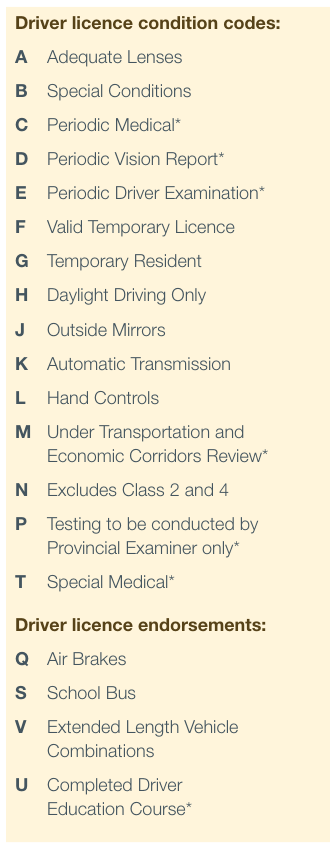
Condition codes
A condition code may be added to a driver’s licence to indicate special requirements. For example, all drivers must meet specific vision requirements to operate a vehicle. If you require glasses or contact lenses to improve your vision to meet these standards, you will have a condition code on your driver’s licence indicating this requirement. Some drivers may require a medical examination by a doctor or a nurse practitioner, which would also be indicated by a condition code. In more extreme situations, a change in a person’s situation can make it impossible to safely operate a vehicle. These situations are not common, but do mean that the person is not able to be licensed to operate a vehicle.
Endorsement codes
An endorsement code on a driver’s licence shows that the person has had specific education or training, such as completing a novice driver education course or a course specific to operating a school bus. An endorsement may also indicate that the person is permitted to drive a vehicle that has a specific feature, such as a vehicle with air brakes. Each condition or endorsement corresponds to a letter code which may be shown on the driver’s licence. Conditions and endorsements specific to you are placed on the front of the licence, in the Cond/End section. Some of the condition codes and endorsements have an explanation on the back of the driver’s licence. Driver licence condition codes: A Adequate Lenses B Special Conditions C Periodic Medical* D Periodic Vision Report* E Periodic Driver Examination* F Valid Temporary Licence G Temporary Resident H Daylight Driving Only J Outside Mirrors K Automatic Transmission L Hand Controls M Under Transportation and Economic Corridors Review* N Excludes Class 2 and 4 P Testing to be conducted by Provincial Examiner only* T Special Medical* Driver licence endorsements: Q Air Brakes S School Bus V Extended Length Vehicle Combinations U Completed Driver Education Course* *Do not appear on the driver’s licence
Re-classing your licence
Guide page 21
When re-classing your driver’s licence (excluding Class 7 to Class 5), you must present proof that you have completed a knowledge test and vision test through a registry agent office. Re-classing your driver’s licence from your current class to a Class 1, 2, or 4 licence will also require a medical report. See the medical requirements section for more information. A fee is charged for each knowledge test, road test, and for the final licence re- classification service. For information knowledge test fee, visit: www.alberta.ca/drivers-knowledge-test.aspx For information on road test fee, visit: www.alberta.ca/drivers-road-test.aspx. Driving with the wrong licence class is against the law. It is an offence for vehicle owners to allow their vehicle to be used by someone who does not have the proper class of licence for that vehicle.
Replacing your Alberta driver’s licence
Guide page 21
If your driver’s licence is lost, stolen, destroyed, or is unreadable, you must apply for a replacement immediately at a registry agent office. If your driver’s licence is stolen, you must report it to the police, and provide a copy of the police report to the registry agent when you apply for your replacement.
Renewing your Alberta driver’s licence
Guide page 22
The Government of Alberta has stopped mailing out reminders about driver’s licences and vehicle registration. Albertans with disabilities will continue to receive reminders in the mail. Albertans can sign up for electronic reminders by visiting E-registry or MyAlberta and signing up for free reminders. It is your responsibility to renew your driver’s licence on or before the expiry date.
Updating your Alberta driver’s licence
Guide page 22
To change the information on your driver’s licence, such as your name, address, or licence class, visit an Alberta registry agent office. You are required by law to ensure the information on your licence is current and accurate. You may be required to provide proper identification before any change, replacement, or renewal can be made. To replace, renew, or update your Alberta driver’s licence, contact a registry agent by visiting: https://www.alberta.ca/lookup/ find-a-registry-agent.aspx
Registration and insurance
Guide page 22
Registration
Motor vehicles and trailers travelling on Alberta roadways must be registered. Registration certificates cannot be issued to anyone under the age of 18 years, unless the application for registration is also signed by a parent or guardian. A parent or guardian has the right to withdraw consent in writing at any time. If consent is withdrawn, the licence plate and vehicle registration will be suspended. The signature of your parent or guardian is not required if you can prove you are married or self-supporting. In Alberta, licence plates remain with the owner of the vehicle and are not transferable to another person. A vehicle owner must register their vehicle within three months of moving to Alberta.
Insurance requirements
All motor vehicles must be insured with a public liability insurance policy as outlined in the Alberta Insurance Act . It is illegal to operate an uninsured motor vehicle. Your insurance company issues a financial responsibility card (pink card) which must be presented when registering a vehicle and when requested by a peace officer.